Showing posts with label Smell. Show all posts

Thursday, November 02, 2006

Brand Sense by Martin Lindstrom 4 of 5

46. Vodaphone owns the red colour and not Coca Cola. Coca Cola has not been consistent. Coca Cola’s new colours are green, yellow and many other different shades in different countries of the world.


47. In the area of sound Microsoft Windows has become the owner of its signature tune. 62% are aware of it. Similarly Nokia has patented its own tune which is easily recognizable. It was invented 7and1/2 years ago. It takes approximately 9 seconds to locate one’s mobile phone and therefore on the basis of receiving on an average 500 calls per month, one can say that one is hearing the tune 15 hours per year. And Nokia is making people aware of it without spending any money. Today there is a 41% awareness of the Nokia tune against a 56% awareness of the Intel tune but only after Intel has spent $ 320 mn. on advertising it.

48. Sound generates mood and memories. It promotes brand awareness. Sound also communicates brand quality. For instance the sound of the car doors closing. It builds brand recognition and builds brand familiarity.

49. We now have an advertisement in ‘People’ magazine that sings an Elvis Presley number. Ads on paper are now talking and singing.

50. According to a research done by Millward Brown it was found that sensibility to sight increases as education increases. With High School education it is 30% while with Graduation/Post Graduation it increases to 45%.


51. Sensitivity to smell is higher among women (28%) than among men (19%). But recall data shows that both sexes are equally affected.


52. Memories get activated and drives brand choice. Our memories are like an untidy, overstocked cupboard. Everything is recalled at once. Senses are the keys to unlocking the cupboard. Experience creates and confirms expectations.


53. Positive experience alone is not enough. Distinctiveness and differentiation also matter. Brand success is more than just a great experience. The components of brand success are : Leader, Clarity, Great experience, and business model.


54. Emotion plays a role between senses and the brand effect. Emotion drives attention and brand processing. Taste is most likely to create the feeling of satisfaction. McDonald’s creates a more cheerful feeling than Burger King.

55. Even among regular users there is a huge difference in loyalty. The more all of the senses are associated the more loyalty is experienced.


56. The Structural Path Model is based on the senses interacting and creating Leadership, a great Experience and Clarity which leads to Choice.
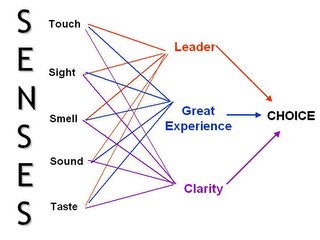


57. Each Brand can be mapped on which senses it is strong or weak. For instance Dove has been shown through research to be balanced on all the senses. While Irish Spring depends more on the sense of smell. Research is now attempting to put financial values on the senses and thereby arrive on the total financial value of the brand.

58. Vision is incredibly important for brands. It gives one the mandate to go beyond the normal. To do something which requires true inspiration and guts. Apple’s vision is “ Man is the creator of change in this world. As such he should be above systems and structures and not subordinate to them” The Credit Lyonnaise Bank’s vision is “You can only be a partner with someone you think of as an equal.”. Vision is not enough. If at the end of the vision statement one crosses one’s brand or company name out and puts competition’s name instead and one finds that there is no difference then throw the vision statement out. There needs to be a tangible difference.


59. At the airport one has these racks for ensuring that only bags of a certain size are carried into the plane as hand baggage. On these racks is usually written all the pertinent legal jargon in fine print which the passenger can hardly read and hardly ever does read. Virgin Airlines thought of this as a branding opportunity in keeping with its Vision and Values. What is written on a luggage rack of Virgin Airlines is “You can have a huge ego but only a bag this size.” This is not bland branding. Need to be provocative and add a sense of humour. This becomes branded jargon vs. legal jargon.


60. We should expect enemies and we therefore need to cut off competition. Even if one’s budget is low one can do something innovative to achieve this. There was a pizza owner in Australia who had a budget of just $700. He used this amount to purchase time on a radio station and the radio spot said the following : “Take your Yellow pages book and tear out all the ‘Pizza pages’ and bring them to his outlet and get a pizza free.” Today he is the biggest pizza owner in Australia.

Friday, October 27, 2006

Brand Sense by Martin Lindstrom 3 of 5

31. We don’t have a name for those who can’t smell or taste.

32. In an African village the people didn’t have names. They knew each other on the basis of the individual smell they had.

33. 90% of Japanese population have no underarm odour. Through research it has been found that the Japanese are more sensitive to the senses than US/UK.

34. Purex Tabs is a floor cleaner. It was a very effective product but smelt very badly. The new marketing manager felt that it would be better to change the smell to a more pleasant one which he did. The sales went down by 42 %. The smell was changed back to the original. The bad smell was associated with its effectiveness.

35. Our senses are finely tuned to pick up signals that warn us of danger. Jack Holly, a U.S. Marine stated “I am alive because of my nose. You couldn’t see a Commie bunker if it was right in front of you. But you can’t camouflage smell. I could smell the North Vietnamese before hearing or seeing them.” We need to brand our daily touchpoints.

36. Crayola Crayons have a patented smell. So when the Chinese imitated Crayola Crayons including the packaging it was very difficult to distinguish the original from the imitation except through the smell.

37. The no. 1 recognizable smell in USA is coffee. No. 2 is peanut butter. And no. 18 is Crayola Crayons.

38. We have been given our senses to understand our world. According to Prof. Gerald Zaltman (Harvard Business School) the brain processes smell more quickly than the other senses. Metaphorically from the nose to the brain would require 3 to 4 jumps while for touch would require around 1000 jumps. Our sense of smell registers in our emotional brain where judgements are made. According to Helen Keller “Smell is a potent wizard”.

39. We also remember smells according to the time when we were born. Before 1930 people would remember the smell of hay, pine, horse and meadow. After 1930 the smells remembered would change to J&J Baby Powder, Crayon Crayola and Vanila.

40. Smell triggers memories and affects brand perception. The McDonald’s smell is greasy and associated with stale oil. It makes you feel fat even before you enter the outlet. Smell creates brand associations. Burger King is associated with the smell of ‘grilled’. The smell of fresh popcorn is used to draw people into the cinema halls. Smell impacts purchase decisions. A new car has a distinctive smell. Smell can’t be turned off.

41. Within Barclay’s Bank they brew coffee so that the customer may feel at home.

42. The smell of a new car comes about with the car being sprayed 2 hours before it leaves the factory. Rolls Royce has broken up its trademark smell into 800 odour components and created ‘Eau Rolls Royce 1965’ which is sprayed into every new Rolls Royce. Post 1965 the sales increased.

43. Singapore Airlines patented the smell of its ‘hot towels’ in 1995. One can get the Singapore Airlines smell while one is on the aerobridge and about to enter the aircraft. The cosmetics used by the airhostesses are patented Pantone shades viz. SIA face colour, eye colour and lip colour. The way the plate is placed in front of the passenger is determined. There is a brand manager on every flight who notices if there is any infringement regarding any aspect of the Singapore brand. If there is any infringement then the person concerned goes back to the Singapore brand school.

44. In an experiment conducted in Las Vegas it was found that by spraying a particular smell people gambled more and the revenue earnings of the casino increased. In a Nike experiment 84% preferred the pair which was sprayed with a smell than the pair which did not have any smell sprayed on it. And they were willing to pay extra for the pair with the smell. Similarly it has been found that in the part of the store where a particular scent has been sprayed people spend more time and money than in any other part of the store which does not have any scent sprayed.

45. 82% felt that Coco Cola tasted better from a glass bottle than from a can. The tactile experience too is important.

Wednesday, October 25, 2006

Brand Sense by Martin Lindstrom - 2 of 5

16. There are certain words which are owned by Disney and are recognized by people as being associated with the Disney Brand. These words are : Fantasy, Dreams, Magic, Smiles, Happy, Creativity. The personnel in Disneyland use these words. These words are built into the lyrics of Disney songs. And so on.

17. Colgate owned the smile but it has gone to Disney and Mcdonald’s.

18. One needs to create a difference in the mind.

19. We are too focused on the visual aspect of branding. We need to see how we can brand ‘sound’.

20. The James Bond movie theme song. In fact James Bond has branded so many things around it. The logo, ‘Bond, James Bond’, ‘Shaken not stirred’, the gadgets, the vintage scenes, the title introduction, character names, the gun, the topic, the filming and so on.

21. The Olympics today are no longer about the 4 rings but about the rituals surrounding the Olympics like the carrying and lighting of the flame, the opening ceremony and so on.

22. Strong emotions are generated by rituals. Brands need to create rituals around themselves.

23. Always over-deliver. Martin Lindstrom went to The Peninsula Hotel. It’s known for having your own type of music made available, through downloading, for you in your room. This time when he went he was told that for some reason this perk would not be there. He felt disappointed. But he was asked what music he liked. He mentioned Eminem, Beatles etc. To his surprise he had hardly settled down in his room when there was a hotel room boy with the CDs of Eminem, the Beatles and so on. Martin has mentioned this story to now over millions of people through his seminars, interviews, books and so on. The cost of overdelivery was approximately $22 which was the cost of the CDs.

24. We need to ask ourselves the following questions :
# Which signal do we own ?
# What would we like to own ?
# Identify the top 3.
# Take it to the extreme.
# Secure ownership
# Establish a brand manual which is human and not legalistic
# Be patient
# Test for ownership

25. By the age of 65 a person in USA would have watched 2 mn. Commercials. This is equivalent to seeing TV commercials 8 hours each day for 7 days a week for 6 years.

26. TV commercials don’t work anymore. The recall level of ads has decreased from 34% in 1965 to 1.5 % today. The TV spends keep on growing. 20% would own a TiVo by 2007 in USA and 14% around the world. Murdoch will shortly be launching a set-top box which would be able to store all the movies ever produced in any language.

27. 83% of all information which people receive is visual. The visual is over-communicated. Branding is about all the 5 senses. Benjamin Franklin said “Tell me and I’ll forget. Show me and I might remember. Involve me and I’ll understand.”

28. We recall best what we smell more than what we see. The sense of smell emotionally affects human beings upto 75% more than any other sense.

29. The gradation of sensory importance shows that after visual there is smell and then audio, taste and touch.

30. The sense of taste and smell are one where the laboratory is the mouth and the nose is the chimney.

To be Continued.....

Friday, October 20, 2006

Brand Sense By Martin Lindstrom

1. Branding is what goes on in one’s mind.


2. Brand is not a logo. The test is that if one removes the logo, will one still be able to recognize the brand !


3. Traditional communication no longer works because we are being over-communicated to.


4. What appeals to as many senses will be remembered.


5. The story goes that the challenge given to Coco-Cola was to create a bottle that if smashed could still be recognized from its glass pieces. Therefore the meaning of ‘Smash your Brand’ is that one needs to look at all the small pieces which the brand can be broken into and see what the brand can make its own.


6. The Brand wheel is a tool which indicates portions of real estate which a brand can optimize and own viz. Picture, Colours, Shapes, Name, Language, Icons, Sound, Behaviour, Service, Tradition, Rituals and Navigation.


7. Orange has appropriated a colour. Absolut branded ‘spelling error’. So it’s variants are Rasberri, Vanilia, Kurant and so on. The brand needs to own something else besides the logo. Absolut has also branded the shape of its bottle.


8. The icon of the ‘Idea’ brand is the ‘Sumo Wrestler’. So if one removes the logo and keeps only the Sumo Wrestler the brand ‘Idea’ will be recognized.


9. Brand creates community and belonging.


10. Louis Vuitton was renovating its store in Paris. To do that it created a façade in the shape of its luggage bags and accessories. The people remembered the façade. In fact they identified with it. To the extent that when it was going to be pulled down after 2 years when the renovation was complete there was a demonstration outside the store.


11. The Tiffany Box is trademarked. The shade of Pantone colour used for the Tiffany box is owned by Tiffany. Therefore one needs to get permission from Tiffany if one wants to use the same shade of colour.


12. Branding is about consistency.


13. Today Pepsi owns the colour ‘blue’. Pepsi took it away from IBM. If one wants to secure ownership then one needs to stick with it.


14. The Peuguot car has branded the ‘0’ in the middle of its car plate numbers. The story goes that the creator of the Peugot car used to experience breaking the number in the middle into 2 pieces for using the crankshaft to get the car started. Because the crankshaft had to pierce that number. So he thought that if the crankshaft had to be inserted into a ‘0’ then there would not be any breakage of a number into 2 pieces. And so all Peugot cars have ‘0’ in the middle of their car plate numbers.


15. Ipod now has extended its branding to even its earplugs. By seeing a person with the Ipod earplugs one can recognize an Ipod user.